Our Blog
How Does Customs Clearance Work in the UAE
Customs clearance services in the UAE cover the documentation, declaration, and coordination work required before imported or exported goods can continue to their destination, a process that runs through official channels like Dubai Customs and Abu Dhabi Customs, under the federal oversight of the Federal Authority for Identity, Citizenship, Customs and Port Security (ICP). Declarations are typically filed through digital platforms such as Dubai's Trade Portal, with Mirsal 2 serving as the core processing engine behind it, while Abu Dhabi coordinates much of its clearance through the unified TAMM government services system. The exact steps can vary depending on the shipment, commodity, origin, destination, and applicable regulations. Customs clearance services UAE businesses rely on typically work best when coordinated as part of a wider freight movement, connecting clearance requirements with transportation, storage, and delivery planning rather than treating it as a separate task.
What Are Customs Clearance Services, Exactly?
Moving goods across international borders involves more than transportation; it involves accurate documentation, customs declarations, regulatory checks, duty-related processing, and coordination before cargo can continue to its destination.
The exact steps can shift depending on the shipment itself: what's being moved, where it's coming from, where it's headed, and what documentation is already available. Shipments moving through Dubai's ports and airports increasingly pass through digital pre-arrival review; Abu Dhabi Customs' own 2025 figures show pre-arrival clearance made up 82% of all clearance procedures across the emirate's customs ports in the first eight months of the year, according to data published via Abu Dhabi Media Office. That shift toward reviewing shipments before they physically arrive is part of why accurate, complete documentation matters earlier in the process than it used to.
What Documents Are Usually Required?
Documentation sits at the center of the whole process, and it's usually where things go wrong if they're going to go wrong at all.
At a basic level, clearance typically requires:
- Commercial invoices and packing information
- Shipping documents (bill of lading or airway bill)
- Declarations and supporting paperwork specific to the goods
- Certificates of origin, where the destination requires them
- Permits, where the shipment category requires them
Incomplete or inconsistent information tends to create the most avoidable delays. If quantities on a packing list don't match the invoice, or a declaration references details that aren't backed up by supporting paperwork, that mismatch is usually what triggers a query, not the goods themselves being a problem. Reviewing shipment details and available documentation before submission, ideally alongside a freight forwarding service that already knows the free zone vs. mainland distinctions, tends to catch most of this early.
How Does Duty and Compliance Get Handled?
Customs processing can involve duty and tax-related information as well as regulatory requirements tied to particular goods categories.
Businesses are generally expected to provide accurate shipment details and supporting documentation so this can be coordinated correctly; there isn't a single flat duty figure that applies evenly across all goods, since rates and applicable regulations shift depending on what's being shipped and where it originated (import duty commonly sits near 5% on a wide range of goods categories, though this varies by product and trade agreement). This is part of why clearance support tends to work best when it's planned early, alongside the shipment itself, rather than pieced together once cargo has already arrived at a port like Jebel Ali or an airport like DXB.
What Happens If Authorities Request More Information?
Where authorities request additional information, clarification, or inspection, timely coordination becomes the deciding factor in how quickly things move again.
A query or inspection request isn't necessarily a sign something's wrong; it's often just part of standard processing for certain goods or routes. What matters more is how quickly the requested information gets back to the right people. Clear communication between the importer or exporter, the customs team, the freight provider, and any other involved party is usually what keeps a shipment moving rather than stalling at this stage.
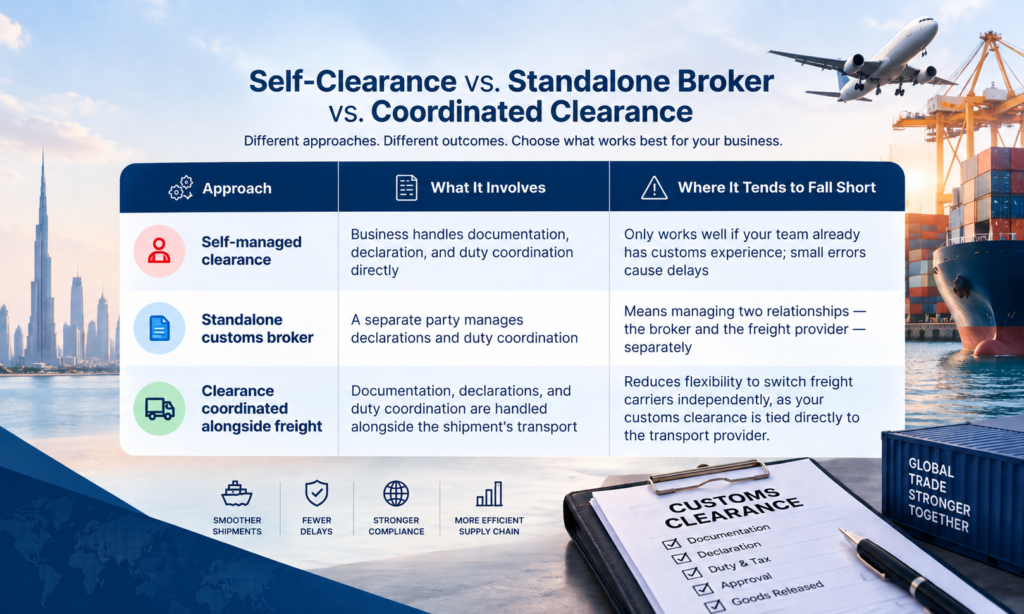
Self-Clearance vs. Coordinated Clearance: A Practical Comparison
What Happens Between Booking and Delivery?
Here's the honest version of the process, stripped of jargon:
You (or your forwarder) book space with an airline. The forwarder prepares the Air Waybill — think of it as the shipment's passport — along with any other paperwork the route requires. The cargo goes through export screening, gets loaded, flies, clears customs at the other end, and finally reaches the recipient, often door to door if that's what you've arranged.
What makes Dubai specifically fast isn't the airport building; it's the map. DXB can reach roughly two-thirds of the world's population within an eight-hour flight. That's a real operational edge, not marketing language, and it's part of why the hub has stayed resilient even when global air cargo demand wobbles.
Roughly, the stages look like this:
- Booking and Air Waybill prep
- Export clearance and security checks
- Loading onto the flight
- Import clearance at destination
- Final delivery
Nothing exotic — but skip a step, or get the paperwork wrong, and the whole timeline slips.
What Does It Actually Cost?
Air freight pricing comes down to "chargeable weight", whichever is higher between what your shipment actually weighs and what it weighs based on its dimensions (volumetric weight). Airlines bill on the bigger number, not the one you'd prefer.
On top of the base rate, expect fuel surcharges, security fees, and whatever handling charges apply at the destination. And pricing isn't static — global air cargo volume crossed 131 million metric tonnes in 2025, up 3.3% from the year before, largely on the back of e-commerce demand. When demand climbs on popular routes, so do rates.
Because of all that variability, nobody serious quotes air freight off a flat rate card. It's route-specific, cargo-specific, and season-specific, which is why getting an actual quote beats guessing from a price list.
Air, Sea, or Sea-Air — Which One Fits Your Shipment?
This really comes down to one question: how much is speed worth to you?
What are customs clearance services?
Customs clearance services cover the documentation, declaration, and coordination required to move imported or exported goods through applicable regulatory checks before they continue to their destination.
hat documents are usually required?
Commercial invoices, packing information, shipping documents, declarations, and any permits specific to the goods category are typically needed.
Does customs clearance apply to imports and exports?
Yes, though the specific documentation and declaration requirements differ between goods entering the UAE and goods leaving it.
Can customs clearance be coordinated with freight services?
Yes — clearance can be planned alongside sea, air, or road freight movement so documentation and transport timelines are managed together rather than separately.
Can cargo be stored after customs clearance?
Yes, warehousing support can cover the period between clearance completion and the next stage of transportation or distribution.
Why does accurate coordination matter?
Because clearance timing is closely tied to shipment planning, documentation issues or delayed responses to inspection queries can affect how quickly cargo continues moving, and increasingly that review starts before cargo even arrives at the port.
Planning Clearance Around Your Shipment, Not After It
Customs clearance is closely tied to shipment timing and supply chain planning; generally speaking, documentation issues, missing information, or delayed responses to a query can all affect how quickly cargo actually moves. A structured process gives businesses a clearer way to prepare documents, coordinate requirements, and respond when authorities ask for more.
Treating clearance as part of the wider cargo movement, rather than a separate step handled after the fact, is really the point. SeaQuest Shipping
coordinates customs clearance as part of wider cargo movement, connecting documentation and compliance requirements with transportation, storage, and final delivery planning from the start.
Latest Blogs